

 The Taj Mahal (sometimes called "the Taj") is generally considered the finest example of Mughal architecture, a style that combines elements of Persian, Turkish, Indian, and Islamic architectural styles. While the white domed marble mausoleum is the most familiar part of the monument, the Taj Mahal is actually an integrated complex of structures. It was listed as a UNESCO World Heritage Site in 1983 when it was described as a "universally admired masterpiece of the world's heritage.
2. Christ the Redeemer in Rio de Janeiro, Brazil.
 Christ the Redeemer is a large Art Deco-style statue of Jesus Christ in Rio de Janeiro, Brazil. The statue stands 32 m (105 feet) tall, weighs 1000 tons and is located at the peak of the 710-m (2330-foot) Corcovado mountain in the Tijuca Forest National Park, overlooking the city.
As well as being a potent symbol of Christianity, the statue has become an icon of the city.
3. The Colosseum in Rome, Italy.
The Colosseum or Coliseum, originally the Flavian Amphitheatre (Latin: Amphitheatrum Flavium, Italian Anfiteatro Flavio or Colosseo), is a giant amphitheatre
 in the centre of the city of Rome, Italy. Originally capable of seating around 50,000 spectators, it was used for gladiatorial contests and public spectacles. It was built on a site just east of the Roman Forum, with construction starting between 70 and 72 AD under the emperor Vespasian. The amphitheatre, the largest ever built in the Roman Empire, was completed in 80 AD under Titus, with further modifications being made during Domitian's reign.
4. Great Wall Of China, China
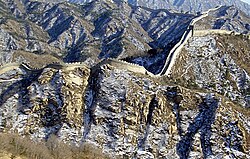 The Great Wall of China is a series of stone and earthen fortifications in China, built, rebuilt, and maintained between the 5th century BC and the 16th century to protect the northern borders of the Chinese Empire during the rule of successive dynasties. Several walls, referred to as the Great Wall of China, were built since the 5th century BC, the most famous being the one built between 220 BC and 200 BC by the first Emperor of China, Qin Shi Huang. That wall was much further north than the current wall, built during the Ming Dynasty, and little of it remains.
The Great Wall is the world's longest human-made structure, stretching over approximately 6,400 km (4,000 miles) from Shanhai Pass in the east to Lop Nur in the west, along an arc that roughly delineates the southern edge of Inner Mongolia. It is also the largest human-made structure ever built in terms of surface area and mass. This is the only man made structure visible from space.
5. Chichen Itza in Yucatan, Mexico.
 Chichen Itza (from Yucatec Maya chich'en itza', "At the mouth of the well of the Itza") is a large pre-Columbian archaeological site, an ancient city built by the Maya civilization, located in the northern center of the Yucatán Peninsula, present-day Mexico.Chich'en Itza was a major regional center in the northern Maya lowlands from the Late Classic through the Terminal Classic and into the early portion of the Early Postclassic period. The site exhibits a multitude of architectural styles.
6. Petra, Jordan
 Petra is an archaeological site in Jordan, lying in a basin among the mountains which form the eastern flank of Arabah (Wadi Araba), the large valley running from the Dead Sea to the Gulf of Aqaba. It is famous for having many stone structures carved into the rock. The long-hidden site was revealed to the Western world by the Swiss explorer Johann Ludwig Burckhardt in 1812. It was famously described as "a rose-red city half as old as time" in a Newdigate prize-winning sonnet by John William Burgon. Burgon had not actually visited Petra, which remained accessible only to Europeans accompanied by local guides with armed escorts, until after World War I.
7. Machu Picchu, Cuzco, Perú

Machu Picchu is a pre-Columbian city created by the Inca. It is located at 2,430 m (7,970 ft) on a mountain ridge. Machu Picchu is located above the Urubamba Valley in Peru, about 70 km (44 mi) northwest of Cusco. Forgotten for centuries by the outside world, although not by locals, it was brought back to international attention by archaeologist Hiram Bingham in 1911, who made the first scientific confirmation of the site and wrote a best-selling work about it. Peru is pursuing legal efforts to retrieve thousands of artifacts that Bingham removed from the site.
Other than these 7 Pyramids Of Giza, Egypt will retain its title of wonder.. beeing the only surviving wonder of ancients time(Not sure will they call it 8th wonder or what)
Pyramids of Giza, Egypt (Already Selected)
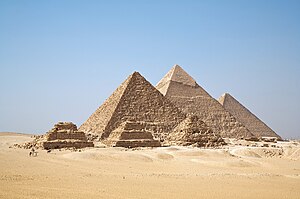 The Giza Necropolis stands on the Giza Plateau, on the outskirts of Cairo, Egypt. This complex of ancient monuments is located some eight kilometres (5 mi) inland into the desert from the old town of Giza on the Nile, some 25 kilometres (12.5 mi) southwest of Cairo city centre.
This Ancient Egyptian necropolis consists of the Pyramid of Khufu (known as the Great Pyramid and the Pyramid of Cheops), the somewhat smaller Pyramid of Khafre , and the relatively modest-size Pyramid of Menkaure , along with a number of smaller satellite edifices, known as "queens" pyramids, causeways and valley pyramids, and most noticeably the Great Sphinx. Current consensus among Egyptologists is that the head of the Great Sphinx is that of Khafre. Associated with these royal monuments are the tombs of high officials and much later burials and monuments (from the New Kingdom onwards), signifying the reverence to those buried in the necropolis.


No comments:
Post a Comment